


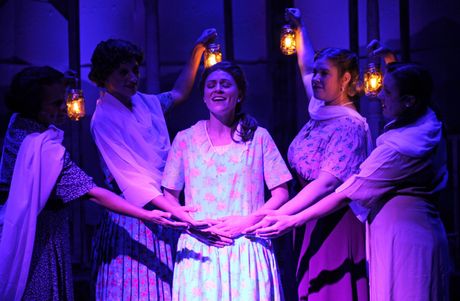
I recently finished teaching my first directing class and it was a fascinating thought experiment. How do you take something you do almost intuitively, decipher it, structure it, and present it so that knowledge can be transferred? Not that directing is akin to astrophysics, but this is exactly what the Carl Sagans and Neil deGrasse Tysons do: take complex ideas and make them accessible. Perhaps this is easier when you've been formally trained, but in community theatre we often learn by doing. I am not formally trained in directing, but I am trained in observing. I do not recall what initial spark led me to wanting to try my hand at directing. Maybe it was being in enough shows, seeing my wife successfully direct, wanting a new challenge, or perhaps simply the arrogance of youth...maybe all of the above. At the time I was at Theatre Salina and approached Executive Director Michael Spicer about directing. He said I could shadow him on productions he was directing. So I sat and watched. I watched him direct Beauty and the Beast and Brighton Beach Memoirs . At some point, Michael let me give notes to the cast. Upon hearing my notes, he was satisfied that I was considering the work on a deep enough level and consequently felt confident enough to slate me as a director for the upcoming season’s production of Silent Sky in Theatre Salina’s blackbox space. Heck yeah. Space and theatre. The process of directing Silent Sky is mostly a blur. I knew the text was already amazing, I had excellent tech folks around me, and a stellar, hardworking cast. The show went well enough that Michael suggested we enter it into AACTFest. I didn’t know what that meant. Never heard of it. So I cut the script, we remounted the production within the guidelines, and we kicked some butt, taking the production to Nationals in Gettysburg where I ultimately won the award for Best Director for the festival, with the production winning four other awards overall. I was a nervous wreck the whole time and barely enjoyed myself. It was surreal. Winning a National Award on my first production kind of messed me up though. I had terrible imposter syndrome. I could not articulate why the production was successful beyond a gut feeling that we created something beautiful. Had I used up all my creativity? Would I be able to ever successfully direct a show again if I didn’t understand how I fostered the magic? What if I don’t get as strong a cast? What if the writing isn’t as good? What if my intuition is completely dried up on the next one? Should I even do the next one or should I quit while I was ahead? What if, what if, what if….? Turns out the next show went pretty well. The one after that was okay, but the one after that was just as beautiful as Silent Sky. Learning by doing. Fast forward a few years. Now I need to teach this stuff? I’d better figure out what in the world I am doing. Here’s what I am doing, but I encourage you to thoroughly develop the methods that work for you. I work best when I consider the underlying framework of a system. For the system of directing, I divided up duties into three key pillars: 1) Creativity and Interpretation, 2) Management and Logistics, and 3) Culture. Pillar One: Creativity and Interpretation This is what most people think of when they hear “directing.” You need to thoroughly understand the script, character motivations, the calculus of the characters (how do they change over time), what does the world look like? What pictures are being made? This is where most of the sausage gets made: pure artistic process. This process is where I ran into trouble on Silent Sky . I intuitively understood the show. I was an accidental dramaturg from studying physics in undergrad. I was operating purely on instincts, which led to unhelpful notes like: “No that’s not right, try it again…no that’s also not right. Almost but...it needs to be more…you know…” This is obviously frustrating to the actors. The issue was that I had instinct, but I couldn't articulate the vision. Takeaway: I only give a note if I can concisely convey what I want. Barring that, I flag the situation and do not say anything until I can accurately describe what I want and back it up with the text. Directing at its core is just communication. If I can communicate like Sagan and deGrasse Tyson, I can clearly convey great meaning. There is so much more to discuss in this pillar, but for now, a great starting place is Backwards and Forwards by David Ball. Short and sweet. Pillar Two: Management and Logistics The director cannot just live in their artistic brain. They must be grounded in their logistical brain as well. How do people, items, and information move throughout the production process? We provide structure. We provide routine. We wrest order from chaos. Simply put, the director needs to have a logical plan. Are auditions organized so that auditionees are in the best position possible to give you their best? Do you have a plan for rehearsal? Have you spoken with your choreographer so that when the song ends, your lead is on the correct side of the stage for the upcoming blocking? How does this set piece get from over here to over there? And so on. You need a system. Takeaway: Create logical systems that work in your space and thoroughly prepare. The more organized you are, the more the actors can focus on giving you their best performance. Pillar Three: Culture The pillar of culture reminds us to continually ask the question: Why the doodle are we doing all of this in the first place? This is hard, it is stressful. Watching a movie is so much easier. Why? Why?! We do it for the people, the relationships, the community. If the people, the relationships, and the community are not locked in, they will find other things to do. We must consciously think of giving our actors/crew/volunteers/patrons warm, thoughtful experiences. This is not a commentary on the types of shows you program, but rather the feelings you want people to leave with when the experience is over. How do we create an environment where people keep coming back? Where actors feel safe to give you their all? Why are we doing this? We do it to enrich our lives. Yes the art is cool-but at the community theatre level, the people you meet along the way are even cooler. Takeaway: Shows come and go. Make sure the people don’t. The point of all this isn’t to prescribe a singular way of looking at the world of directing. The purpose is to stop and think critically about your personal system. How would you articulate your process? Is it a vestige of tradition that no longer serves you or your organization’s needs? The three pillars of directing are how I make sense of the process. How do you? Chaz Coberly, JD, MFA President, Association of Kansas Theatre
Community theater runs on volunteer energy. Every rehearsal represents people sacrificing evenings with family, time after work, sleep, and personal obligations in order to create something together. Because of that, rehearsal efficiency is not just a scheduling issue. It is a leadership responsibility. That does not mean rehearsals should feel rigid, joyless, or mechanical. Theater should absolutely leave room for spontaneity, laughter, discovery, and creativity. But structure and creativity are not opposites. In many ways, structure is what allows creativity to flourish without wasting people’s time. I have increasingly come to believe that every rehearsal teaches a cast how rehearsals are supposed to work. If leadership enters the room prepared, focused, calm, and intentional, the room often reflects those qualities back. If leadership communicates clearly and keeps momentum moving, casts tend to stay engaged. But when rehearsals become disorganized, unclear, or constantly reactive, the room can quickly drift into confusion and distraction. I recently came across the concept of “emotional contagion” in a review published in The Leadership Quarterly , where researchers discuss the way emotions and behavioral patterns spread through groups, particularly in leadership environments. In simple terms, emotional contagion is the tendency for people to unconsciously absorb and mirror the tone, energy, and behavior of those around them. That idea immediately resonated with me in the context of theater rehearsals. If leadership enters a room calm, focused, and intentional, casts often reflect those qualities back. But if leadership appears scattered, reactive, or unfocused, that energy can spread just as quickly throughout the room. Actors, dancers, musicians, and technicians are trained observers. Theater artists constantly read body language, pacing, tone, energy, timing, and emotional cues. Ensemble work depends on synchronization. We spend countless hours learning how to respond to one another truthfully and instinctively. In rehearsal spaces, that sensitivity can become both a strength and a challenge. When a rehearsal has clear momentum, people naturally lock in. When a rehearsal loses momentum, people naturally drift. Most of us have seen some version of this same feedback loop: Leadership becomes uncertain or improvisational. Instructions become less clear. Cast members ask clarifying questions, which interrupts momentum further. Downtime increases while adjustments are made on the fly. Side conversations begin. Attention splinters across the room. Eventually, the cast may appear unfocused or disengaged, but often they are simply reflecting the environment they have been placed in. Importantly, this is not about blaming individuals. Creativity and leadership are not always the same skill set. A person can be extraordinarily imaginative, passionate, and artistically gifted while still struggling to manage the flow of a rehearsal room efficiently. In fact, some of the most creative people generate ideas so quickly that organization becomes difficult in real time. That does not make them bad artists. It simply means that leadership requires additional skills beyond creativity alone. Teaching requires preparation. Good teachers do not walk into a classroom hoping inspiration appears. They prepare lesson plans, anticipate problems, create contingency plans, and structure time intentionally while still remaining flexible enough to adapt when needed. Rehearsal leadership works much the same way. The strongest rehearsals I have experienced usually share the same underlying rhythm: there is a plan. The plan may change, but the room can feel that structure exists. The next objective is already anticipated. Transitions happen quickly. Expectations are clear. Momentum is protected. Even moments of spontaneity feel supported because they occur inside an organized framework. That structure communicates something important to volunteers: your time matters. In community theater especially, this matters enormously. Many rehearsals already stretch late into the evening after long workdays. A rehearsal that routinely drifts without focus does not just cost time; it costs energy, morale, and eventually retention. Burnout rarely comes from hard work alone. More often, burnout comes from the feeling that time and effort are being wasted. Leadership culture is contagious in both directions. Focus spreads. Calm spreads. Preparation spreads. But confusion spreads too. The encouraging part is that rehearsal culture is not accidental. It can be intentionally shaped. Small leadership choices — arriving prepared, communicating clearly, minimizing unnecessary downtime, maintaining emotional steadiness, respecting schedules — all influence the behavior of the room around them. Theater is collaborative by nature, and collaboration always involves shared emotional energy. The tone set by leadership does not stay isolated at the top. It echoes outward into the entire rehearsal process. Every rehearsal teaches the cast how rehearsals are supposed to work. The question for all of us in leadership positions is simple: what are we teaching? Chaz Coberly, JD, MFA President, Association of Kansas Theatre
Season programming has always been one of the most interesting—and honestly, most intimidating—parts of running a theatre. Every year, we sit down with a blank calendar and try to answer the same question: what will our community want to see? For a long time, my answer leaned on a familiar structure. Open with a big, exciting musical. Add a strong Christmas production that feels familiar and family-friendly. Close with another large “tentpole” show. In between, sprinkle in a mix of comedy, drama, and maybe a classic or contemporary play. On paper, that approach makes sense. It’s balanced, it’s recognizable, and it reflects a lot of what community theatre has traditionally done. But as I’ve been preparing for the 2026–2027 season , I’ve been sitting with the ideas in Robert Gard’s Grassroots Theater , and it has pushed me to rethink something pretty fundamental: what if programming isn’t just about selecting good shows, but about reflecting the actual life of the community the theatre serves? That sounds simple. Almost obvious. But the more I’ve thought about it, the more complicated—and more interesting—it becomes. In practice, it raises a hard question: when we program a show, are we inviting the community into something that reflects them, or are we asking them to trust us that what we’ve chosen is worth their time? In a place like Manhattan, where we’re still building and strengthening audience habits around live theatre, that distinction matters. Many people aren’t coming in with years of theatre-going experience. They’re making a choice in real time, often with limited context. So if our programming only relies on recognizable titles or assumptions about what “works,” we risk missing a deeper opportunity to connect. Gard’s idea of theatre as a reflection of community started to shift how I think about that responsibility. This upcoming season, I’ve tried to make a few intentional changes—not to abandon structure, but to embed the community more directly into the work itself. We’re still opening with a strong musical. There is still value in that shared, high-energy moment that signals the season has begun. Some traditions exist for a reason. But instead of filling the middle of the season with a standard off-the-shelf play, we are commissioning a work specifically rooted in Manhattan. The goal isn’t to turn it into something narrowly local. The goal is to tell a universal story that is grounded in the places, rhythms, and people of this community. My hope is simple: when audiences see it, they recognize something familiar in it—not just in setting, but in spirit. We’re also rethinking what a holiday production can be. Instead of defaulting to a traditional seasonal title, we are producing The Nutcracker in partnership with K-State School of Dance, Washington Dance Studio, and the Ballroom Dance Club. The intent here is to widen the circle of participation. The production becomes less about presenting a finished product and more about creating a shared experience across multiple parts of the local arts community. And for our season closer, Dear Evan Hansen offers a different kind of opportunity. The show already explores communication, isolation, and connection through digital space. We’re exploring ways to reflect that visually by incorporating community voices into projections and recorded material—small moments that allow local presence to become part of the storytelling itself. What ties all of this together is not a rejection of traditional programming, but a shift in emphasis. I still believe in strong openings, familiar anchors, and big closing moments. But I’m starting to believe more deeply that at least a few productions each season should do more than present a story—they should actively involve the community in the making of it. I don’t know yet exactly how this will land with audiences. That’s the part that remains to be seen. But it feels like a step toward something more grounded and more reciprocal for where we are right now—less about assuming trust, and more about building it through participation. If theatre is going to thrive in communities like ours, it may not be enough to ask, “What shows should we do?” We may also need to ask, “How do we make this feel like it belongs to the people we are doing it for?” And for me, at least for the 2026–2027 season , that question is shaping everything. Chaz Coberly, JD, MFA President, Association of Kansas Theatre